
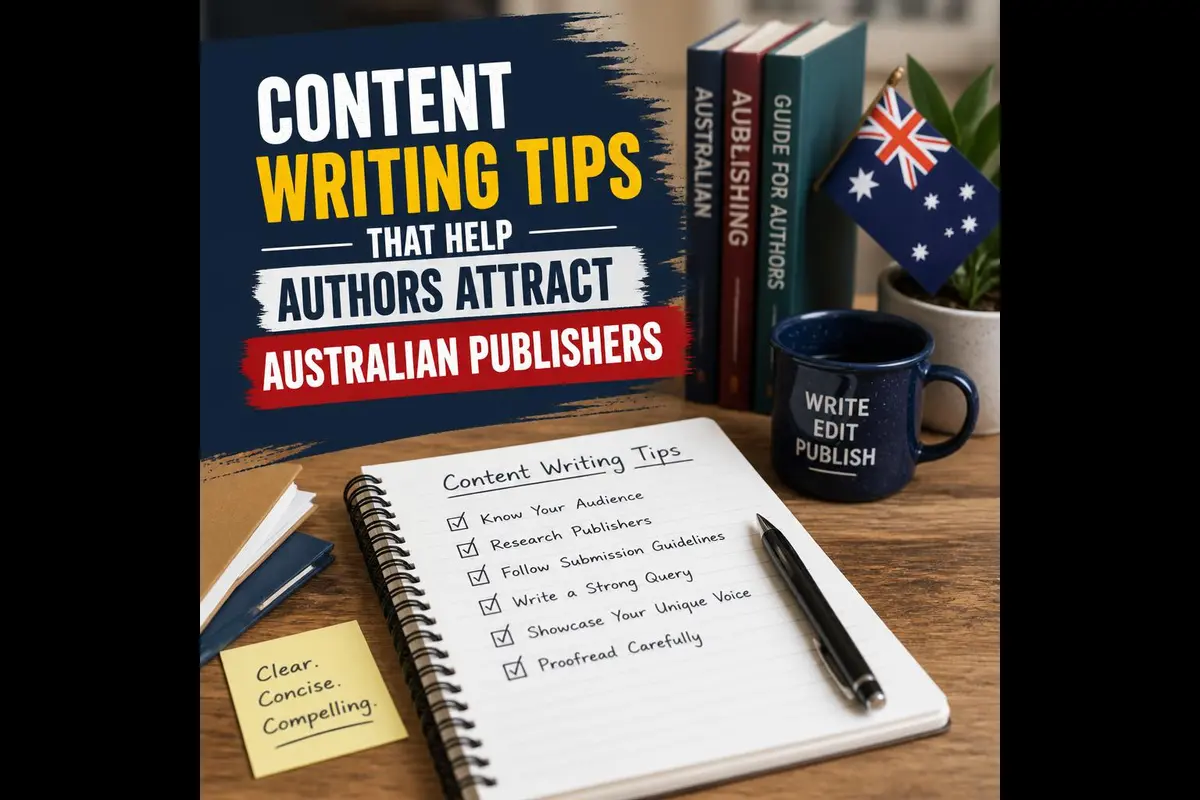
Content Writing Tips That Help Authors Attract Australian Publishers
Do you want your manuscript to shine amid the stiff competition in the Australian literary scene? Ensure that your story is in line with the current reader demands, remove the fluff with intensive editing, and present impressive platform statistics up front.
Strong Ideas Create Better Publishing Opportunities
Writing a book can take months, but a publisher could decide whether to continue reading in the opening pages. That may seem extreme, but remember good writing is not necessarily sufficient.
Publishers want to see manuscripts that present an idea, a voice, an audience and a need for readers to care. They also like to invite authors who know how they can present their work professionally.
The Australian publishing industry spans the breadth of trade, educational, scholarly and independent publishing. The Australian Publishers Association speaks for over 200 publishers, which is rather a wide market.
If you want to go into this field as an author, the idea is not to make your manuscript sound complicated. It’s to create every page to be useful, understandable, and memorable.
Create A Strong Opening That Captures Attention
Your opening is the first place to get an editor excited.
If you’re writing fiction, begin with a movement, emotion, conflict, or an unusual situation. In nonfiction, tell readers the question or problem or the idea that your book will address.
A strong opening doesn’t need dramatic language. It needs direction.
Read the first 2 pages like you’re reading them for the first time. Consider: Do I really want to read the next page? If the answer is no, then your opening needs to be looked at again.
Australian Publishers usually look for manuscripts that have a great opening, interesting ideas, reader appeal, good writing, and distinctive voice.
Provide A Clear Purpose For Each Chapter
If each chapter in the manuscript has some value, the manuscript is easier to read.
Do not write because you have information to share, but rather because you have a purpose for each chapter. A chapter can establish a character, describe a major concept, set up a problem, or influence the reader toward a solution.
Before finalizing your draft, consider whether each chapter:
- Adds something new
- Shows understanding of the central idea
- Supports the story by moving it forward
- Provides readers with helpful information
- Relates to the next chapter naturally
This will eliminate unnecessary filler. It also facilitates editing as you can easily mark out portions that duplicate the information or are too weak.
Turn Difficult Ideas Into Clear, Engaging Content
No one wants to read a sentence that’s difficult to read simply because the writer wants to sound smart. Simple writing can have a big impact. Short sentences, familiar words, and clear explanations keep the reader focused on the idea and not the words.
When an idea is challenging, provide examples. Use simple words in place of technical jargon. Divide lengthy explanations into shorter parts.
Enhance Your Manuscript With Smart Research
Research can help add depth and credibility to your writing.
In nonfiction, reliable research can help support claims, provide examples, and avoid inaccuracies in facts.
In fiction, research can make it seem more believable when you are making settings, professions, historical periods, and characters more believable.
Maintain well-organized research throughout the writing process. Save source information as you go rather than going back and trying to create your own list of sources.
Polish Your Manuscript To Strengthen Every Idea
The end of your first draft is a milestone; it is not the finish line.
The initial editing pass should be on the macro level. Analyze the organization, pacing, sequence of chapters, and message of the text.
Then work towards smaller details. Refine paragraphs, eliminate repetition, shorten sentences, and correct unclear language. A final proofreading pass can pick up any spelling, grammatical, punctuation, and formatting errors.
If you don’t notice the weaknesses in the manuscript because you’ve read it so many times, external resources can help you. Professional Content writing services can also assist you in maintaining your personal style while ensuring your content is clear, organized, and easy to read.
Write A Pitch That Keeps Publishers Interested
A publisher may not be able to discover the value of your book gradually. The central idea must be easily understood in your pitch.
In fiction, tell the reader the central character, central conflict, and the reasons for the story’s interest. In nonfiction, describe the central issue, your idea/solution, and your intended reader.
Position Your Book For More Robust Market Appeal
Publishers must know where your book fits into the marketplace. Don’t write what you believe will sell. Rather, determine which readers are most likely to relate to your work.
Consider other books that are alike. How is your project going to be unique from them? Do you sound different? Does the book help you to solve a different problem? Does it take a new approach to a familiar topic?
Understanding the target audience can influence the title, pitch, face orientation, description, and promotion of your cover.
Prepare Your Manuscript For Professional Presentation
When you submit your manuscript to a publisher, it should be neat. Don’t use distracting fonts, unusual layouts, too many design elements, or inconsistent formatting.
Ignore style and decoration, and instead focus on readability unless directed by the publisher. The title page, chapter headings, spacing, page numbers, and paragraphs should be consistent.
Book printing Australia services can offer information on formats, paper options, binding, quantities, and other production factors which could be of interest to authors who want to opt for physical production options.
FAQs
What can authors do to make their manuscripts more attractive?
Begin with a solid opening statement, proper organization, a natural voice, and a fresh point of view. Revise carefully and be sure that the manuscript reflects the interests of the publisher. Editors can also get to know the book’s value quickly from a clear pitch and target audience.
Do authors need to research their publisher before they submit?
Yes. It is important to do publisher research to see if there is a publisher that will match your manuscript catalog, audience, and publishing interests. It can also help you personalize your pitch and find similar titles to make your submission more meaningful and relevant.
Why is an author biography important?
An author biography is helpful to give information about your background and relationship with the book. Make it brief and to the point. Include information about your professional background, qualifications, publications, or personal experiences that will support your ability to write the specific manuscript.
Why should I hire a professional editor?
Sometimes, using professional editing when you require an impartial look at your manuscript can be helpful. An editor can spot multiple ideas, weak sections, sentences that don’t follow, pacing problems, or structural problems that may not be clearly apparent to the writer after having been working on the text for months.
What do authors need to do before they submit?
Review the latest guidelines from the publisher, proofread, refine your pitch, and ensure that all documents requested are submitted. Don’t rush to submit. A quick last look can help ensure that any errors are not overlooked and that the final submission looks professional.
Conclusion
Getting a publisher is a process that starts before you send your first email and manuscript. It begins with writing a book that is on point and has a specific audience.
By using clear language, well-structured chapters, thorough research, original ideas, careful editing, and a focused pitch, publishers will be able to understand and assess your work easily.
Avoid impressing the reader by making your manuscript complicated. Be clear, helpful, memorable, and meaningful. This type of writing provides an author with a stronger chance of making a well-rounded manuscript a viable publishing opportunity.

Anna Smith is a content strategist and digital marketing writer for Content Mills – Britain’s #1 Content Writing Services @ £49, and she covers the ins and outs of the content creation industry, plus business marketing, and also how to scale editorial operations.